


Building the Brain of a Robot: A Deep Dive into Physical AI


Introduction
Artificial intelligence has spent most of its history operating inside the digital world. Machine learning models learned patterns from structured data, computer vision systems interpreted images, and large language models learned to understand and generate language. More recently, agentic AI has started connecting these models to tools, APIs, databases, browsers, and software systems, allowing AI to reason about a goal and execute a sequence of digital actions.
The next major evolution is the movement of AI from the digital world into the physical world.
This is the domain of Physical AI.
Physical AI refers to artificial intelligence systems that can perceive and understand physical environments, reason about what is happening around them, make decisions, perform physical actions, and learn from the consequences of those actions. Instead of simply generating an answer, a Physical AI system can interact with the environment that produced the problem in the first place.
A useful way to think about the progression is that traditional AI primarily learned to predict, generative AI learned to create, agentic AI learned to execute digital tasks, and Physical AI is learning to act in the physical world.
The distinction is important because the physical world introduces a completely different level of complexity. A software agent can retry an API call if something goes wrong. A physical machine may not have that luxury. An incorrect digital recommendation can be corrected with another response, whereas an incorrect physical action can break an object, damage equipment, or create a safety risk. Physical AI therefore requires the combination of intelligence, perception, physical modeling, robotics, control systems, simulation, and safety engineering.
What Exactly Is Physical AI?
At its core, Physical AI is a closed-loop intelligence system.
The machine first observes its environment through sensors. It interprets those observations and develops an understanding of the current state of the environment. It then reasons about the objective it has been given, plans one or more actions, executes those actions through its physical actuators, observes the resulting state, and continues the process.
The fundamental loop can therefore be expressed as:

A Physical AI system typically follows:
Sense → Understand → Plan → Act → Observe → Adapt
For example, imagine a robot instructed:
"Bring me the red cup from the kitchen."
The system needs to:
Perceive — Use cameras, microphones, LiDAR, force sensors, etc.
Understand — Identify the kitchen, cup, obstacles and spatial relationships.
Plan — Determine a sequence of movements.
Control — Move its arms, wheels, or legs.
Interact — Pick up the cup without breaking it.
Adapt — If the cup moves or an obstacle appears, change the plan.
That's fundamentally different from an LLM simply answering:
"The red cup is probably in the kitchen."
A Physical AI system does not merely make a prediction about the environment. Its actions can change the environment, which means the next decision depends partly on the consequences of the previous decision.
This creates an important concept: embodied intelligence.
Intelligence is no longer isolated from the environment. The intelligence is embodied in a system that has sensors, a physical form, capabilities, limitations, and an ability to interact with the world.
A robot, autonomous vehicle, drone, industrial machine, or other intelligent physical system can therefore be considered an embodiment through which AI interacts with reality.
Why Physical AI Is Hard?
The physical world is significantly more complicated than a digital environment.
Digital systems tend to operate on relatively well-defined abstractions. An API either returns a response or does not. A database contains a particular value. A software process follows a defined execution path.
The physical world is continuous, uncertain, noisy, and only partially observable.
Objects may move unexpectedly. Lighting can change. Sensors can produce noisy measurements. Objects can have different shapes, textures, weights, and friction properties. Humans behave unpredictably. Mechanical systems have tolerances and imperfections. A robot's actual movement may differ slightly from the movement predicted by a mathematical model.
Consequently, Physical AI has to deal with uncertainty at almost every level.
A robot does not simply need to know that an object exists. It may need to estimate the object's three-dimensional location, orientation, size, material, physical properties, and relationship to surrounding objects. It must then determine whether the object can be manipulated, how it should be approached, what type of grasp should be used, how much force should be applied, and what could happen after the object is moved.
This makes Physical AI a much broader discipline than simply applying an LLM to a robot.
The Architecture of a Physical AI System
A modern Physical AI system can be viewed as a collection of interconnected layers.
At the bottom is the physical hardware. This includes sensors, motors, actuators, batteries, computing hardware, communication systems, mechanical structures, and other components that allow the machine to interact with its environment.
Above this is the robotics software layer. This handles functions such as localization, mapping, motion planning, kinematics, navigation, trajectory generation, collision detection, and low-level control.

Above the robotics layer is the AI intelligence layer. This can contain computer-vision models, vision-language models, large language models, vision-language-action models, reinforcement-learning policies, world models, and task-planning systems.
The highest level can contain an agent or supervisor that understands human instructions, decomposes complex objectives into smaller tasks, selects appropriate capabilities, monitors execution, and determines when replanning is necessary.
The resulting architecture is therefore closer to an AI ecosystem than to a single model.
A simplified representation is:
Human goal → AI reasoning → world understanding → planning → robot policy → motion planning → control → physical action → sensors → feedback → AI reasoning
The feedback loop is critical. Without feedback, the system is essentially executing a predefined script. With feedback, it can continuously adapt its behavior based on what is actually happening.
Perception: Giving Machines the Ability to See and Sense
The first requirement for physical intelligence is perception.

Humans use vision, hearing, touch, balance, and other senses to construct an understanding of their surroundings. Physical AI systems use cameras, depth sensors, LiDAR, radar, microphones, inertial measurement units, force sensors, tactile sensors, joint encoders, GPS and other sensing technologies.
Raw sensor data is not directly useful to a high-level reasoning system. It has to be transformed into meaningful information.
A camera provides pixels. A perception system needs to transform those pixels into concepts such as objects, people, surfaces, locations, movements, and relationships.
Modern computer vision and multimodal foundation models have significantly expanded the capabilities available at this layer. Vision-language models can associate visual information with language and semantic concepts, making it possible for a machine to reason about scenes at a higher level than traditional object-detection systems.
However, perception is not simply about recognizing objects. Physical AI requires state estimation.
The system needs to maintain an estimate of what is happening in the environment at a particular point in time. This may include where objects are located, how they are moving, where the robot itself is located, and what has changed since the previous observation.
This creates the foundation for physical reasoning.
From Scene Understanding to World Models
One of the most important concepts emerging in Physical AI is the world model.
A world model attempts to represent the environment and, more importantly, how that environment changes over time.

Consider the difference between recognizing a ball and understanding a ball.
Recognizing a ball means identifying an object as a ball.
Understanding the ball involves reasoning about its position, velocity, shape, interaction with surfaces, possible trajectories, and the consequences of different actions.
A Physical AI system ultimately needs to answer questions such as:
What is happening now?
What could happen next?
What happens if I perform this action?
Which action is most likely to achieve my objective?
This is why world models are potentially so important.
Rather than directly mapping an observation to an action, the system can attempt to model possible future states and use those predictions during planning.
This is closely related to model-based decision making. The AI can consider possible consequences before taking an action, rather than relying entirely on trial and error in the real world.
The concept is especially important because collecting physical experience can be expensive. If a system can learn something about the physical world through simulation or learned world models, some of that knowledge can potentially be transferred to physical machines.
Reasoning and Planning
Perception tells the system what is happening. A world model can help represent what could happen. Planning determines what the system should do.
This is where modern AI reasoning models can become particularly valuable.
A high-level instruction is rarely a single physical action. It normally represents a sequence of activities that must be performed in a particular order.
The AI therefore needs to convert a high-level objective into a sequence of intermediate goals.
This creates a hierarchical architecture.
At the highest level, a reasoning model understands the objective. A task planner decomposes that objective into subtasks. A skill-selection layer determines which capabilities should be used. A motion planner determines how the physical movement should occur. Finally, a controller converts the planned movement into commands for the physical hardware.
This hierarchy is extremely important.
A large language model should generally not be responsible for directly controlling motors. Language models are powerful reasoning systems, but physical control requires deterministic timing, precise feedback, constraints, and safety mechanisms.
A better architecture is therefore:
Reasoning model → task planner → skill → motion planner → controller → actuator
Each layer solves a different problem.
Vision-Language-Action Models
An important development in Physical AI is the emergence of Vision-Language-Action models, commonly referred to as VLAs.

Traditional language models map language to language. Vision-language models combine visual and linguistic information. VLA models extend the concept further by connecting perception and language to physical actions.
The objective is to learn a relationship between what the machine sees, what it has been instructed to accomplish, and the actions required to achieve that objective.
Conceptually:
Visual observation + instruction + robot state → action
This is a major shift because the model is no longer merely describing the world. It is participating in an interaction with the world.
However, VLAs should not be viewed as replacements for the entire robotics stack. A practical system may still require separate components for localization, motion planning, collision avoidance, safety, and low-level control.
The VLA can provide intelligence at the action-policy level while traditional robotics systems provide the precision and reliability required for physical execution.
The Importance of Simulation
One of the biggest challenges in Physical AI is that real-world data is expensive.
Training an AI system through millions of physical interactions can require enormous amounts of time, hardware, maintenance, human supervision, and operational resources.
Simulation provides an alternative.
A simulated environment can contain a virtual robot, virtual objects, virtual sensors, physics models, environments, obstacles, and other elements required for training.
The AI can then perform thousands or millions of interactions inside the simulation.
This creates a development cycle in which the machine can learn and fail inside a virtual environment before being exposed to the physical world.
Modern robotics platforms such as NVIDIA Isaac Sim and Isaac Lab are designed around these kinds of simulation and robot-learning workflows.
The broader concept is often referred to as sim-to-real: train or validate a system in simulation and then transfer the learned capability to a physical machine.
The Digital Twin
A particularly useful application of simulation is the digital twin.
A digital twin is a virtual representation of a physical environment or system.
For Physical AI, the digital twin can contain not only the physical geometry of the environment but also the robot, sensors, objects, physics properties, and operating conditions.
The closer the simulation is to reality, the more useful it becomes for training and testing.
However, perfect simulation is impossible.
There will always be differences between simulation and reality. Motors behave differently than their mathematical models. Sensors contain noise. Real objects have properties that are difficult to model precisely. Physical environments change.
This is known as the reality gap.
Physical AI development therefore requires techniques that make models robust to these differences.
Sim-to-Real and Domain Randomization
One of the most common approaches is domain randomization. Instead of training a robot in one fixed simulation environment, the system can be exposed to many variations.

Lighting can change. Object positions can change. Textures can change. Friction can change. Sensor noise can change. Robot parameters can vary.
The objective is to prevent the model from memorizing one particular simulation.
Instead, the model learns patterns that remain useful across a distribution of environments.
The overall process becomes:
Simulation → Randomized environments → Policy training → Simulation evaluation → Physical deployment → Real-world validation
The real robot then generates additional data that can be used to improve the system.
This creates an iterative learning cycle rather than a one-time training process.
Learning From Demonstrations
Another important component of Physical AI is demonstration data.
Instead of asking an AI system to discover every behavior through reinforcement learning, humans can demonstrate how a task should be performed.
The system records the observation, robot state, action, and outcome over time.
This produces trajectories of the form:
Observation → Action → Observation → Action → Observation
A large collection of these trajectories can be used to train an imitation-learning policy.
This approach is powerful because humans already possess a large amount of physical knowledge. Demonstrations provide a way to transfer some of that knowledge into a machine-learning system.
Teleoperation can make this process scalable. A human operator controls the robot while the system records the interaction.
Over time, the collected demonstrations can become a specialized dataset for training robot policies.
Reinforcement Learning
Imitation learning is not the only approach. Reinforcement learning allows a robot to learn by interacting with an environment and receiving feedback.
The basic loop is:
State → Action → Environment → Reward → New State
The system attempts to learn a policy that maximizes long-term reward.
For robotics, the reward function may incorporate task completion, efficiency, stability, precision, energy consumption, collision avoidance, or other objectives.
Reinforcement learning is especially attractive when the optimal behavior is difficult to demonstrate manually but can be evaluated automatically. However, pure reinforcement learning in the physical world can be extremely expensive and potentially unsafe. This is another reason simulation is so important.
A robot can perform millions of exploratory actions in a virtual environment without physically damaging expensive hardware.
Foundation Models and Physical AI
The emergence of foundation models changes the economics of Physical AI.
Historically, robotics systems were often developed around narrowly defined tasks. A system was engineered for a particular environment, object set, and operating procedure.
Foundation models introduce the possibility of starting from a much more general representation.
Instead of training a completely new model for every task, developers can potentially start with a pretrained vision, language, world, or action model and adapt it to a specific environment.
This creates a similar paradigm to modern generative AI:
Foundation model → domain data → adaptation → specialized capability
The challenge is that physical environments are much more diverse than digital datasets, and physical actions require much greater precision.
Nevertheless, the trend toward robotics foundation models suggests that Physical AI may increasingly follow a foundation-model paradigm rather than relying entirely on task-specific models.
The Role of AI Agents
Physical AI becomes significantly more powerful when combined with agentic architectures. An agent can operate at a higher level than the robot itself.
The agent receives a goal, reasons about the task, decides which capabilities are required, monitors progress, and replans when something changes.

This creates a hierarchy:
Human → Physical AI Agent → Task Planner → Robot Skills → Robot Controller
The agent does not need to know how every motor works. It needs to understand the available capabilities and decide how to combine them. This leads to an important architectural concept: the robot skill library.
Instead of teaching the system every complete task independently, developers can create reusable physical skills such as navigation, grasping, object detection, manipulation, inspection, docking, opening, closing, lifting, placing, and other capabilities.
A higher-level agent can then compose these skills dynamically. This is analogous to how software agents use tools.
In a digital environment, an agent may have tools such as search(), send_email(), and query_database().
In a physical environment, the available capabilities might include navigate(), grasp(), inspect(), and place().
The fundamental agentic concept remains the same, but the action space has moved from software into the physical world.
Building the Physical AI Data Flywheel
Data may ultimately become one of the biggest competitive advantages in Physical AI.
The valuable dataset is not simply a collection of images. It is a collection of embodied experiences. An embodied data record can contain visual observations, depth information, robot state, joint positions, velocities, actions, instructions, object states, environmental conditions, rewards, failures, and task outcomes. Over thousands or millions of interactions, this becomes a dataset describing how physical environments behave and how actions affect them.
This creates a powerful feedback loop.
The robot generates data. The data improves the models. Improved models produce better behavior. Better behavior produces more useful data.
The cycle becomes:
Deploy → Observe → Collect → Train → Evaluate → Deploy
Synthetic data and simulation can accelerate this loop, while real-world data keeps the models grounded in reality.
The Importance of Edge Computing
Physical AI cannot rely entirely on cloud infrastructure. Some decisions need to happen locally. If a machine is moving near an obstacle or human, waiting for a remote server to process every sensor observation may introduce unacceptable latency.
This creates a hybrid architecture.
Cloud infrastructure can be used for large-scale model training, simulation, dataset management, analytics, fleet management, model evaluation, and model updates.
Edge infrastructure can handle real-time perception, local inference, motion planning, control, and safety-critical processing.
The architecture therefore becomes:

This separation allows sophisticated AI models to coexist with the real-time requirements of robotics.
ROS 2 and the Robotics Software Layer
Physical AI also requires a software middleware layer that allows different robotics
components to communicate.
ROS 2 (Robot Operating System 2) is one of the major technologies used for this purpose. A robotics system may have separate components responsible for cameras, LiDAR, localization, mapping, navigation, perception, planning, control, and hardware drivers. ROS 2 allows these components to communicate through standardized interfaces and message-passing mechanisms.

This modularity is important because Physical AI systems are inherently multidisciplinary.
The perception system can evolve independently from the navigation system. The AI model can be upgraded without rewriting the entire hardware layer. Different sensors can be substituted without redesigning every component.
The result is a modular robotics architecture rather than a monolithic application.
Safety Must Exist Outside the AI
Safety is arguably the most important difference between Physical AI and ordinary software AI. An AI model can make mistakes. Therefore the AI itself should not be treated as the ultimate safety mechanism. A robust system should have independent safety controls that constrain what the AI is allowed to do.
These can include physical emergency stops, speed restrictions, force limits, collision detection, workspace restrictions, human detection, geofencing, hardware interlocks, watchdog systems, and safe fallback behavior.
The architecture should look something like:
AI decision → safety validation → permitted action → controller
If the proposed action violates a safety constraint, it should be rejected regardless of how confident the AI model is.
This is one of the fundamental principles of trustworthy Physical AI:
The AI should operate inside a safety envelope rather than define the safety envelope itself.
Evaluating Physical AI
Evaluating a Physical AI system requires much more than checking whether the model produces a correct answer. The first metric is usually task success. Did the machine actually accomplish the objective?
But task success alone is insufficient.
A system may eventually complete a task while frequently colliding with objects, requiring human intervention, consuming excessive energy, or taking too long.
A comprehensive evaluation framework therefore needs to consider task success, precision, collision rate, safety violations, latency, energy consumption, robustness, generalization, recovery from failure, human intervention rate, and operational reliability.
The evaluation process should also test previously unseen conditions.
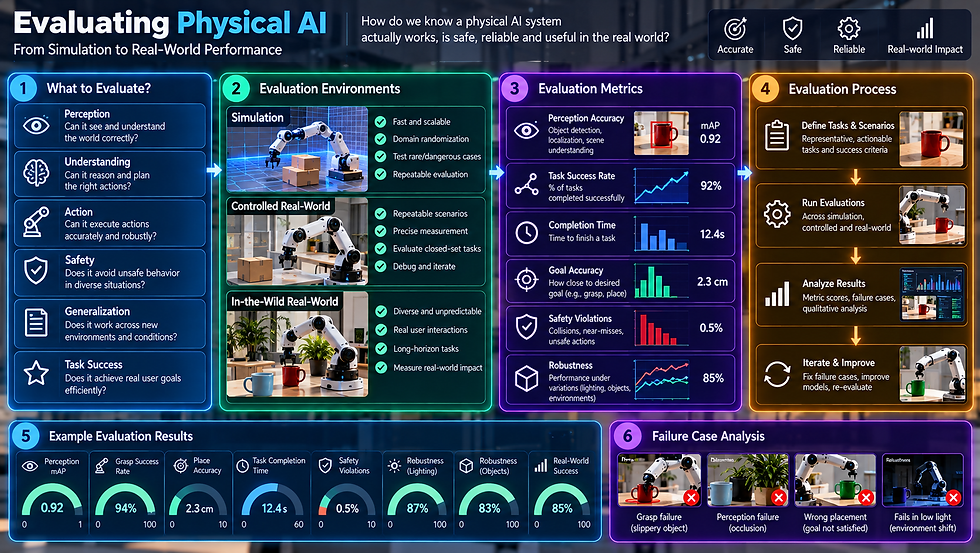
A robot that succeeds 99 percent of the time in one carefully controlled environment may not be useful if its performance collapses when lighting, object position, object appearance, or environmental layout changes.
Generalization is therefore one of the central challenges in Physical AI.
A Practical Development Roadmap
The most effective way to build Physical AI is not to begin with the ambition of creating a fully general-purpose robot.
Start with a single physical capability.
The first stage should involve a narrowly defined task in a controlled environment. The objective is to establish the complete loop from perception through action and feedback.
Once that capability is reliable, the system can be expanded to multiple objects, multiple environments, and multiple variations of the same task.
The next stage is introducing natural-language instructions and connecting the perception and robotics stack to a reasoning model.
After that, reusable physical skills can be developed so that increasingly complex tasks can be composed from existing capabilities.
Simulation should then be introduced at scale to increase the diversity of environments and reduce dependence on physical hardware.
Imitation learning and reinforcement learning can be added as the system accumulates demonstrations and interaction data.
Finally, an agentic supervisor can be introduced to coordinate multiple skills, manage longer-horizon objectives, monitor execution, and recover from failures.
The progression therefore looks like:
Single skill → multiple skills → language-controlled robot → skill composition → simulation → learning → agentic physical intelligence
A Reference Physical AI Stack
A production-oriented Physical AI system can be organized into several layers.
At the hardware layer, there are robots, actuators, cameras, LiDAR, depth sensors, force sensors, compute modules, batteries, and communication systems.
At the robotics layer, there are ROS 2, localization, mapping, navigation, kinematics, motion planning, trajectory generation, and control.
At the perception layer, there are computer-vision models, object detection, segmentation, depth estimation, tracking, sensor fusion, and multimodal models.
At the intelligence layer, there are vision-language models, large language models, vision-language-action models, world models, reinforcement-learning policies, and task planners.
At the agent layer, there are goal management, planning, tool and skill selection, memory, monitoring, recovery, and multi-robot coordination.
At the simulation layer, there are digital twins, physics simulation, synthetic environments, synthetic data generation, reinforcement-learning environments, and sim-to-real validation.
At the infrastructure layer, there are model training, dataset management, experiment tracking, telemetry, fleet management, model deployment, and monitoring.
This layered approach is important because Physical AI is not one technology. It is a complete technology stack.
The Future of Physical AI
The long-term opportunity extends far beyond humanoid robots. Physical AI can eventually become an intelligence layer for factories, warehouses, vehicles, laboratories, hospitals, agricultural environments, construction sites, homes, logistics networks, and other physical environments.

Instead of thinking about a robot as a standalone machine, it may be more useful to think about a physical environment containing many intelligent entities. Sensors continuously observe the environment. World models maintain an understanding of its state. AI agents reason about objectives. Robots and machines execute actions. Humans supervise high-level goals. Data flows back into the learning system.
This could create an architecture analogous to an operating system for the physical world.
The important shift is from individual robots performing predefined tasks to intelligent physical systems that continuously perceive, reason, act, and learn.
Physical AI Is the Convergence of Multiple Fields
Physical AI should therefore not be understood as simply "AI for robots." It is the convergence of several disciplines that historically evolved independently.
Computer vision provides perception.
Robotics provides physical embodiment.
Control theory provides stability and precise movement.
Reinforcement learning provides a framework for learning through interaction.
Simulation provides scalable environments for training and testing.
World models provide representations of physical dynamics and possible futures.
Foundation models provide increasingly general representations.
Edge computing provides low-latency inference.
Safety engineering constrains what the system is allowed to do.
Together, these technologies create something fundamentally different from conventional software AI.
The Physical AI Development Loop
The most useful mental model for understanding Physical AI is not a model architecture. It is a development loop.
A physical system begins with a goal.
It observes the world.
It constructs an internal representation.
It reasons about what should happen.
It selects an action.
It executes that action.
The environment changes.
The system observes the change.
The result becomes new data.
That data is used to improve the model.
The improved model is deployed again.
The loop repeats.
In its simplest form:
Goal → Perceive → Understand → Predict → Plan → Act → Observe → Learn
This is the essence of embodied intelligence.
Conclusion
Artificial intelligence is moving through an important transition. The first major wave of AI focused on prediction and classification. Generative AI expanded AI into creation and reasoning. Agentic AI introduced systems that could autonomously execute digital tasks using tools.
Physical AI takes the next step by connecting intelligence to the physical world.
The challenge is considerably larger because physical environments are uncertain, continuous, dynamic, and safety-critical. Building Physical AI therefore requires much more than training a larger model.
It requires an integrated architecture consisting of perception, world models, reasoning, planning, robot policies, simulation, reinforcement learning, robotics middleware, deterministic control, edge computing, safety systems, and continuous data collection.
The most important development principle is to avoid thinking of Physical AI as a single model.
A useful Physical AI system is a hierarchy of intelligence and control. Foundation models can provide general reasoning and perception. World models can help predict how environments evolve. Agents can decompose high-level objectives. Robot policies can convert those objectives into physical behavior. Motion planners and controllers can execute that behavior precisely. Safety systems can constrain the actions. Sensors can provide continuous feedback.
The resulting system becomes a learning loop:
Simulate → Demonstrate → Train → Evaluate → Deploy → Observe → Learn → Simulate again.
That loop may ultimately be more important than any individual model.
The future of Physical AI is therefore not simply about building machines that can move.
It is about building machines that can understand the world, reason about it, act within it, learn from it, and continuously improve their ability to operate within it.
That is what makes Physical AI one of the most significant frontiers in the evolution of artificial intelligence.


Comments