


mHC: Manifold-Constrained Hyper-Connections by DeepSeek

Rethinking connectivity in large language models using mHC Manifold-Constrained Hyper-Connections

Introduction
Modern deep learning owes much of its success to one deceptively simple idea: residual connections. They made very deep networks trainable and became the backbone of Transformers and large language models (LLMs). But residuals were designed for an era when models were far smaller and information flow was simpler.
As we push toward deeper, wider, and more expressive architectures, residual connections are starting to show structural limitations. Manifold-Constrained Hyper-Connections (mHC), introduced by DeepSeek, propose a principled evolution of residual connectivity—one that preserves stability while dramatically increasing expressive power. This innovation could redefine how future large language models (LLMs) are trained and architected.

This article explains what mHC is, why it exists, and why it matters, without hand-waving.
Why Residual Connections Worked So Well?
Residual connections solve a fundamental optimization problem. Instead of forcing each layer to learn a full transformation, residual networks learn incremental updates:

This design guarantees:
A stable identity path for information
Predictable gradient flow
Depth scalability
Transformers adopted the same principle for attention and feed-forward blocks, and residuals became non-negotiable in LLM training.
But residuals come with a hidden assumption:
There is only one information stream.
Every layer receives a single vector, modifies it slightly, and passes it forward. This assumption becomes restrictive as models grow.
The Limitation: Single-Stream Information Flow
In large models, different kinds of information coexist:
Syntax
Semantics
Long-range context
Task-specific signals
Residual connections collapse all of this into one stream, forcing layers to multiplex responsibilities. This limits representational flexibility and reuse.
A natural question arises:
What if a model could maintain multiple streams of information and let layers redistribute them intelligently?
This is where Hyper-Connections enter.
From Hyper-Connections to mHC: Power, Instability, and the Missing Constraint
To understand Manifold-Constrained Hyper-Connections (mHC), we must start with the motivation behind Hyper-Connections—and why, despite their promise, they fail without additional structure.

Illustrations of Residual Connection Paradigms. This figure compares the structural design of (a) standard Residual Connection, (b) Hyper-Connections (HC), and (c) proposed Manifold-Constrained Hyper-Connections (mHC). Unlike the unconstrained HC, mHC focuses on optimizing the residual connection space by projecting the matrices onto a constrained manifold to ensure stability. Credits
Hyper-Connections: Breaking the Single-Stream Bottleneck
Traditional residual connections operate on a single information stream. Each layer receives one representation, applies a transformation, and adds it back via an identity shortcut. While stable, this design limits how information can be reused or reorganized across layers.
Hyper-Connections generalize this idea by introducing multiple parallel streams of information. Instead of passing a single vector forward, a layer maintains several streams and uses learnable mixing matrices to redistribute information among them before and after the main transformation.
A generic Hyper-Connection layer can be written as:

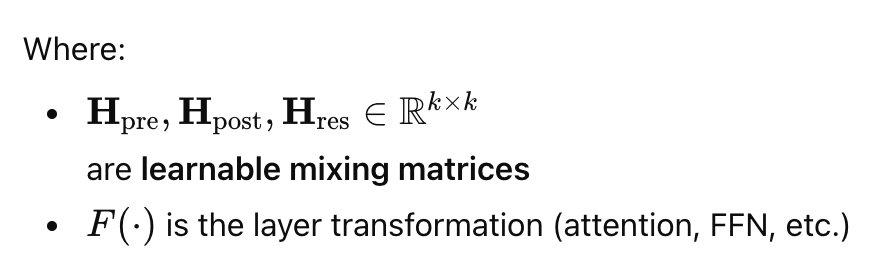
This allows information to move across streams, increasing expressivity and feature reuse.
This design dramatically increases expressive power:
Different streams can specialize in different types of information
Features can be reused and recombined across layers
Representational bandwidth increases without a proportional rise in compute
On paper, Hyper-Connections look like a natural and powerful evolution of residuals.
The Hidden Problem: Loss of Identity and Training Instability
The problem is not expressivity—it is unconstrained freedom.
In standard residual connections, the identity path guarantees that information and gradients propagate safely. Hyper-Connections replace this fixed identity with fully learnable mixing matrices. Over many layers, these matrices are repeatedly composed.
In residual networks, the identity mapping ensures:

Hyper-Connections break this guarantee.
Across many layers, repeated multiplication by unconstrained matrices leads to:

If the spectral norms of Hres(l) are not controlled:

Without constraints, this leads to:
Signal amplification or attenuation
Vanishing or exploding signals
Loss of norm preservation
Poorly conditioned gradients
Training instability at scale
In essence, Hyper-Connections destroy the identity-mapping guarantee that makes residual networks stable. The richer the connectivity, the more fragile the system becomes.
This is why unconstrained Hyper-Connections struggle to scale reliably in deep or large models.
mHC: The Key Insight — Stability Through Manifold Constraints
Manifold-Constrained Hyper-Connections (mHC) solve this problem with a precise and elegant idea:
Keep the multi-stream expressivity of Hyper-Connections, but mathematically constrain how streams are mixed.
In mHC, the mixing matrices are not arbitrary. They are constrained to lie on a manifold of doubly stochastic matrices, where:
All entries are non-negative
Each row sums to 1
Each column sums to 1
This constraint has profound effects:
Information Conservation: Each output stream becomes a convex combination of input streams—no amplification, no loss.
Restored Identity Behavior: Even though information moves across streams, the system preserves identity-like signal propagation.
Stable Layer Composition: Stacking many layers no longer compounds instability; signal norms remain bounded.
Practically, these constraints are enforced through efficient, differentiable normalization methods (e.g., Sinkhorn normalization), making mHC viable for large-scale training.
Why This Works
Hyper-Connections failed not because they were too expressive, but because they lacked structural guardrails.
mHC introduces those guardrails through geometry:
Freedom within streams
Constraint across layers
Stability without sacrificing expressivity
In effect, mHC transforms Hyper-Connections from a risky architectural idea into a scalable, mathematically grounded replacement for residual connections.
Why mHC Is Fundamentally Different from Residuals
Aspect | Residual Connections | Hyper-Connections | mHC |
Streams | 1 | Multiple | Multiple |
Mixing | Fixed identity | Unconstrained | Manifold-constrained |
Stability | Guaranteed | Fragile | Guaranteed |
Expressivity | Limited | High | High |
Scalability | Proven | Unreliable | Proven |
Residuals guarantee stability by limiting freedom.
mHC guarantees stability while allowing freedom, by enforcing structure. That is the real innovation.
Role of Sinkhorn–Knopp algorithm
The Sinkhorn–Knopp algorithm plays a crucial operational role in mHC—it is the mechanism that enforces the manifold constraint during training.
In Manifold-Constrained Hyper-Connections, the mixing matrices between streams must be doubly stochastic (rows sum to 1, columns sum to 1). This constraint is what guarantees signal conservation and stability.
However, neural networks naturally learn unconstrained matrices via gradient descent.
Sinkhorn–Knopp bridges this gap.
What Sinkhorn–Knopp Does
Given a raw (unconstrained) matrix M\mathbf{M}M, the Sinkhorn–Knopp algorithm:
Exponentiates or clamps values to be non-negative
Alternates row normalization and column normalization
Repeats until convergence
Result:

Meaning:
All entries ≥ 0
Each row sums to 1
Each column sums to 1
This projected matrix is then used as the mixing matrix in mHC.
Without Sinkhorn–Knopp:
Mixing matrices drift during training
Signal norms explode or vanish
Hyper-Connections become unstable
With Sinkhorn–Knopp:
Information is conserved
Identity-like behavior is restored
Stacking many layers remains stable
Constraints are differentiable, so backprop works normally
In short:
Sinkhorn–Knopp turns a free-form learned matrix into a mathematically safe routing operator.
The Sinkhorn–Knopp algorithm enforces the manifold constraint in mHC by projecting learned mixing matrices into stable, doubly stochastic form—making expressive multi-stream connections trainable at scale.
Why This Matters for the Future of LLMs
As LLMs continue to scale, progress can no longer rely solely on adding more parameters, data, and compute. At extreme depths, connectivity itself becomes a limiting factor. Residual connections made deep models trainable, but they assume a single, linear flow of information. mHC highlights that how information moves across layers is now as important as what each layer computes, introducing information-flow geometry as a first-class concern in LLM design.
By enabling stable multi-stream architectures, mHC unlocks a new level of expressivity. Different streams within a model can safely specialize—handling syntax, semantics, memory, or reasoning—while still exchanging information without instability. This makes deeper, more modular, and more structured LLMs practically trainable, something that unconstrained architectures have struggled to achieve at scale.
Most importantly, mHC represents a shift from fragile training heuristics to architectural guarantees. Instead of relying on careful initialization or tuning tricks to maintain stability, mHC embeds mathematical constraints directly into the model. This signals a future where LLMs scale through principled architectural design—allowing models to grow deeper and more capable without sacrificing reliability or training stability.
Conclusion
Manifold-Constrained Hyper-Connections (mHC) represent a meaningful step forward in the evolution of neural network architecture. Rather than seeking progress through scale alone, mHC rethinks one of the most fundamental design choices in deep learning: how information flows across layers. By combining the expressivity of multi-stream Hyper-Connections with mathematically grounded stability guarantees, mHC shows that richer connectivity does not have to come at the cost of trainability.
The key insight is simple yet powerful—constraints enable scale. By enforcing manifold-based structure on inter-layer mixing, mHC restores the identity-like behavior that made residual networks successful, while removing the single-stream limitation that now restricts modern LLMs. This allows deeper, more expressive, and more modular models to be trained reliably, even at large scales.
As LLMs move toward greater depth, longer context, and more complex reasoning, architectural innovations like mHC will become increasingly important. The future of large language models will not be defined only by size or data, but by principled design choices that make scaling safe, efficient, and sustainable. mHC offers a clear blueprint for that future.


Comments