


Artificial Intelligence in Nuclear Physics

How machine learning, deep neural networks, and probabilistic Artificial Intelligence are reshaping our understanding of the atomic nucleus — from fusion reactors to particle accelerators.

Introduction
Nuclear physics probes matter at its most fundamental — the dense, positively charged nucleus occupying a volume roughly 10^{-15} meters across, yet holding nearly all of an atom's mass. For decades, the field advanced through painstaking theoretical frameworks and purpose-built experiments: bubble chambers, cyclotrons, large arrays of scintillators. The data volumes were manageable, the models analytic, and human intuition reigned supreme.
That landscape is changing rapidly. Modern facilities — CERN's ALICE detector, the Facility for Rare Isotope Beams (FRIB) at Michigan State, the National Ignition Facility (NIF) in California, and JET/ITER in Europe — generate petabytes of data per year. The complexity of the many-body nuclear problem, the non-perturbative nature of the strong force at low energies, and the breadth of applications from energy to medicine make nuclear physics one of the most fertile grounds for artificial intelligence.
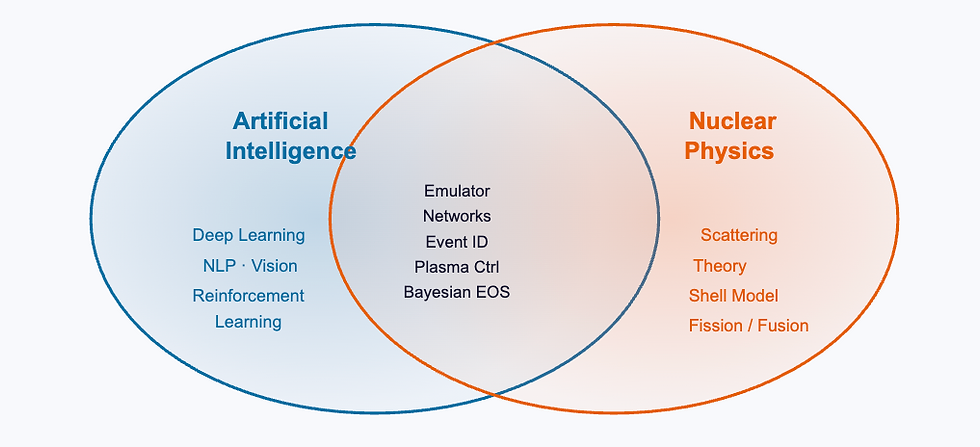
AI techniques — ranging from classical machine learning and Bayesian inference to deep convolutional networks and reinforcement learning — are now embedded throughout the nuclear physics pipeline: designing experiments, identifying rare decay events, predicting nuclear properties, controlling plasma in fusion reactors, and accelerating ab initio calculations that once demanded months of supercomputer time.
Nuclear Structure & Binding Energy
A central challenge in nuclear physics is predicting the ground-state properties of nuclei across the entire chart of nuclides — nearly 3,000 experimentally observed species, with several thousand more predicted. The most successful semi-empirical description remains the Bethe–Weizsäcker liquid-drop formula, which models the nucleus as an incompressible charged fluid:

where:
B(Z,A) = Total nuclear binding energy
Z = Number of protons
A = Total nucleons (protons + neutrons)
N=A−Z = Number of neutrons
While elegant, this formula has systematic residuals — especially near magic numbers where shell effects dominate. Neural networks have been employed to learn these residuals directly from data. Researchers at CERN and various national laboratories have trained feedforward networks and Gaussian-process regressors on experimental binding energies from the Atomic Mass Evaluation (AME), achieving root-mean-square errors below 0.5 MeV — competitive with or surpassing the best microscopic models for interpolation tasks.
Shell Model Emulators
The nuclear shell model describes nucleon motion in a mean field with residual two-body interactions. The Hamiltonian for $n$ valence nucleons in a shell-model space is:

Exact diagonalization (e.g., via the Lanczos method) becomes computationally intractable for nuclei with many valence nucleons. AI-based emulators — trained on a subset of full calculations — can predict eigenvalues and eigenvectors orders of magnitude faster. The eigenvector continuation (EC) method, combined with Gaussian process emulators, enables rapid uncertainty quantification over the space of nuclear interactions.

Nuclear Reactions & Cross-Sections
Understanding how nuclei interact — scattered, fused, or broken apart — is encoded in the reaction cross-section σ In quantum mechanics, the differential cross-section for elastic scattering is given by the Born approximation:

In practice, the optical model potential contains a real part (elastic scattering) and an imaginary part (absorption into reaction channels), and fitting it to experimental angular distributions is a classic inverse problem. Modern ML pipelines use Gaussian processes and Bayesian neural networks to infer the posterior distribution over optical model parameters, quantifying uncertainties that propagate into reaction network calculations for nuclear astrophysics and reactor design.
Hadronic Interaction Networks
At higher energies, hadron–nucleus and nucleus–nucleus collisions produce thousands of secondary particles. The Relativistic Heavy-Ion Collider (RHIC) at Brookhaven and ALICE at LHC record ~10^7 events per second. Identifying signatures of quark–gluon plasma (QGP) — a state of matter present microseconds after the Big Bang — requires separating rare collective-flow signals from overwhelming hadronic backgrounds.
Graph neural networks (GNNs) have shown remarkable power here: each particle track is a node, and edges encode proximity in momentum space. The network learns graph-level representations to classify events (QGP vs. hadronic resonance gas) with AUC scores above 0.97, far surpassing traditional cut-based analyses.
Key Result: A 2024 ALICE collaboration study deployed a transformer-based particle flow network that reduced the false-positive rate in J/ψ suppression searches by a factor of 12 compared to the previous boosted-decision-tree approach, enabling observation of a new centrality-dependent suppression pattern consistent with color-screening in the QGP.
Artificial Intelligence in Nuclear Fusion
Nuclear fusion — the process powering the Sun — releases energy through the combination of light nuclei. The most accessible reaction for terrestrial power is deuterium–tritium (D–T):

Confining the plasma at temperatures exceeding 10^8 K in a tokamak requires precise real-time control of magnetic field coils. Plasma instabilities — notably edge-localized modes (ELMs) and tearing modes — can disrupt the plasma and damage vessel walls within milliseconds. This is where reinforcement learning (RL) has achieved a historic milestone.
DeepMind's Plasma Control
In 2022, DeepMind and the Swiss Plasma Center published a landmark result in Nature: a deep reinforcement learning agent trained in a simulation of the TCV tokamak learned to control the shape and position of the plasma by directly actuating 19 magnetic coils. The agent achieved a variety of target configurations — including an experimental "snowflake" divertor shape — without requiring hand-crafted control laws.
The RL objective maximizes a reward signal encoding plasma shape fidelity, stability metrics, and constraint satisfaction. The policy is parameterized by a neural network mapping plasma state st (from magnetic sensors, Thomson scattering, and bolometry) to coil voltage commands ut:

:

Disruption Prediction
Major disruptions — sudden loss of plasma confinement — can release stored energies of several hundred megajoules in under 10 ms, posing severe risks to the machine. ITER, the international experiment under construction in France, cannot tolerate more than a handful of major disruptions over its lifetime. Early prediction is therefore critical.
Recurrent neural networks (LSTMs) and transformer-based models trained on multi-machine disruption databases (JET, ASDEX-U, DIII-D) have achieved disruption warning times of 20–100 ms ahead of the event with false positive rates below 5% — sufficient to trigger mitigation systems that inject noble-gas pellets to gently terminate the plasma.
Particle Detectors & Signal Processing
Modern nuclear physics experiments depend on detecting and identifying particles produced in reactions. A detector system typically measures energy deposition, time-of-flight, and track topology to reconstruct the full kinematics of an event. The fundamental challenge is signal-to-noise: rare processes of interest (e.g., double-beta decay, exotic resonances) are buried beneath orders-of-magnitude more common backgrounds.
Convolutional Networks for Gamma Spectroscopy
High-purity germanium (HPGe) detectors record gamma-ray spectra from radioactive sources. Traditional peak-fitting algorithms (e.g., GF3, Radware) rely on Gaussian fits to individual photopeak lines. CNNs operating on the full spectrum have been shown to identify isotopes in complex mixtures — including overlapping peaks and Compton-scatter continua — with substantially higher accuracy, particularly for low-activity sources or short measurement times.
Track Reconstruction with GNNs
Tracking charged particles through gaseous detectors (Time Projection Chambers, TPCs) is a classic combinatorics problem: thousands of space-points must be connected into a small number of continuous trajectories. The computation scales as O(N^2)
or worse for classical Kalman filtering. GNN-based trackers (e.g., Exa.TrkX, used at the sPHENIX experiment) reduce this to near-linear complexity by constructing a graph of candidate hit-pairs and using edge-classification networks to prune fake connections.

Pulse Shape Discrimination
In neutron detectors (EJ-301 liquid scintillator, CLYC crystals), neutrons and gamma rays produce pulses of subtly different shapes. Traditional charge-integration methods compute a ratio of integrals over a "long" and "short" gate. CNNs processing the raw digitized waveform at nanosecond resolution achieve figure-of-merit values (FOM) significantly higher than traditional methods, especially at low energies where the pulse shapes converge and separation is most challenging.
Quantum Chromodynamics & Lattice QCD
Quantum Chromodynamics (QCD) is the fundamental theory of the strong force, describing how quarks interact via gluon exchange. The QCD Lagrangian density is:

At low energies, QCD is non-perturbative and analytic solutions are intractable. Lattice QCD discretizes spacetime onto a 4D grid and computes the path integral numerically via Monte Carlo sampling. Even with petaflop supercomputers, generating a single ensemble of gauge configurations takes weeks, and the cost grows steeply with the lattice spacing and inverse quark mass.
Flow-Based Generative Models
Normalizing flows — generative neural networks that learn invertible transformations between a simple prior distribution and a complex target — have emerged as transformative tools for lattice QCD. Rather than generating samples via Markov chain Monte Carlo (with its critical slowing-down near the continuum limit), a trained flow network generates independent, identically distributed gauge configurations in a single forward pass.

Results from the DeepMind / MIT / Cambridge collaboration (2023) demonstrated 10–100× improvements in effective sample size over HMC for scalar field theories in 2D, with active work extending these gains to full 4D SU(3) gauge theories relevant for hadron spectroscopy.

Nuclear Waste & Safety Applications
Nuclear power plants generate spent fuel that remains radioactive for hundreds of thousands of years, including long-lived actinides such as ²³⁷Np, ²⁴¹Am, and ²⁴⁴Cm. Safe characterization and disposal require knowing the isotopic composition and activity of waste packages — information that is often incomplete or uncertain due to incomplete burn-up records.
AI-based passive gamma assay systems use spectral unfolding — trained on libraries of simulated and measured spectra — to infer isotopic inventories non-destructively. Convolutional autoencoders can learn compact latent representations of gamma spectra that cluster naturally by waste matrix type, enabling anomaly detection for undeclared materials in safeguards applications.
Reactor Physics Emulators
The neutron diffusion equation governs the spatial distribution of the neutron flux Φ(e, E, t) in a reactor core:

Physics-informed neural networks (PINNs) solve differential equations by embedding the governing PDE as a regularization term in the training loss, eliminating the need for mesh generation while providing smooth solutions. For reactor core analysis, PINNs trained on a small number of high-fidelity simulations can predict flux profiles and power distributions for new fuel loading patterns in milliseconds — compared to hours for traditional nodal codes — enabling real-time reactor optimization during refueling outages.
Radiation Transport Surrogates
Monte Carlo codes (MCNP, OpenMC, Serpent) provide benchmark-quality solutions to the Boltzmann transport equation but require 10^8 - 10^9 particle histories for convergence in shielding calculations. Neural network surrogates trained on design-of-experiment (DoE) Latin hypercube samplings of the parameter space can reproduce dose-rate maps to within 3% in microseconds, accelerating shielding design iteration by 4–5 orders of magnitude.
Challenges & Future Outlook
Despite remarkable progress, several fundamental challenges remain. First, interpretability: neural networks are powerful interpolators but often provide little physical insight. A model that accurately predicts binding energies is less useful if it cannot inform our understanding of which many-body correlations dominate — a core scientific question. Developing physically transparent architectures (e.g., message-passing networks encoding known symmetries) is an active area.
Second, data scarcity: nuclear physics datasets are small compared to those driving progress in computer vision and NLP. The chart of nuclides contains only ~3,000 measured species; many properties have been measured for far fewer. Transfer learning, active learning, and uncertainty-aware Bayesian methods are essential to extract maximum value from limited data.
Third, extrapolation: predictions for exotic nuclei far from stability (e.g., neutron-rich isotopes produced at FRIB or RIKEN) require models to extrapolate beyond the training distribution — precisely where accuracy matters most for nuclear astrophysics (r-process nucleosynthesis) and for designing next-generation isotope harvesting facilities.

Conclusion
Looking ahead, quantum machine learning may offer a natural synergy with nuclear physics. Variational quantum eigensolvers (VQEs) running on near-term quantum processors could parameterize nuclear wave functions in Hilbert spaces inaccessible to classical architectures — particularly for strongly correlated systems near magic numbers or the drip lines. The interplay between AI-augmented theoretical frameworks and next-generation experimental facilities (FRIB, FAIR, EIC) promises a decade of transformative discoveries in our understanding of nuclear matter.
In fusion energy, the stakes are existential: AI-driven plasma control and disruption mitigation are now on the critical path to commercial fusion power. The convergence of reinforcement learning, physics-constrained surrogates, and high-bandwidth digital twin infrastructure makes the 2030s plausibly the decade in which fusion transitions from scientific achievement to engineering reality — with AI as an indispensable partner at every step.
Bottom line: AI is not merely a tool for nuclear physicists — it is reshaping the epistemic foundations of the field, blurring the boundary between simulation and experiment, and enabling questions to be asked (and answered) that were simply out of reach a decade ago. The greatest open challenge is ensuring that these powerful models remain grounded in physical principles, carry honest uncertainty estimates, and drive — rather than obscure — genuine scientific understanding.


Comments