


The State of Simulation for Physical AI

From GPU-powered physics engines to generative world models, simulation is becoming the training ground for the next generation of intelligent robots.
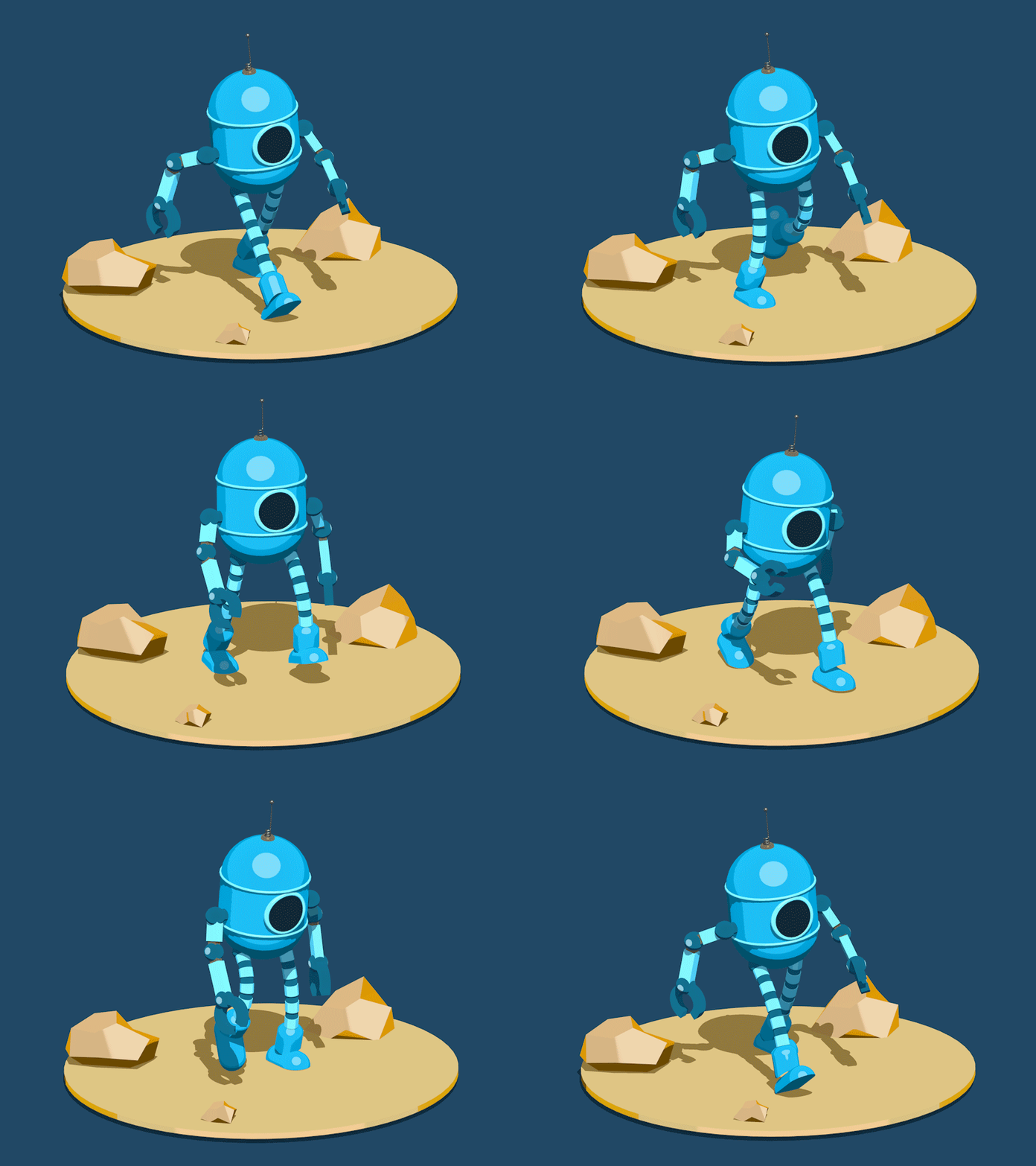
"Before Robots Take Over the World, They'll Learn to Live in a Virtual One."
Introduction
Physical AI — systems that perceive, reason, and act in the real world through embodiment (robots, autonomous vehicles, industrial manipulators, humanoids) — faces a fundamental bottleneck that digital AI largely avoided: data. Large language and vision models trained on internet-scale text and images; physical systems require experience of contact, friction, deformation, sensor noise, and the irreversible consequences of actions. Collecting that experience on hardware is slow, expensive, risky, and often impossible at the required scale.
Simulation has therefore moved from a debugging and visualization tool to the central substrate of Physical AI development. It supplies the volume, safety, controllability, and diversity needed to train perception models, reinforcement-learning policies, imitation-learning datasets, and emerging vision-language-action (VLA) foundation models. In 2026 the field is characterized by rapid advances in GPU-accelerated physics, photorealistic rendering, real-to-sim reconstruction, hybrid classical/neural world models, and a growing open-source stack.
Imagine teaching a humanoid robot to walk. You could put it in a laboratory and let it try. It takes a step, loses its balance, and falls. Engineers inspect the failure, adjust the controller, and try again. Repeat this thousands of times, and the robot might eventually learn to walk.
Now imagine doing the same thing with 10,000 virtual robots simultaneously. Some walk on slippery floors. Others carry heavy objects. Some encounter unexpected obstacles, while others learn to recover from a fall.
They can experiment around the clock without damaging expensive hardware. When their training is complete, the best-performing policies can be transferred to a physical robot for testing.
This is the promise of simulation for Physical AI.
But the story goes much deeper than virtual robots learning to walk. Simulation is evolving from a tool engineers use to test their designs into a platform where AI systems learn, generate experience, predict outcomes, and prepare for real-world interaction.
The convergence of GPU computing, physics engines, synthetic data, digital twins, and generative AI is changing how physical intelligence is developed.
The central question is no longer simply whether we can simulate the physical world.
It is:
Can we build virtual worlds that teach machines enough about reality to operate reliably within it?
Let's explore where simulation stands today, how the technology works, which platforms are shaping the ecosystem, and what remains unsolved.
Why does Physical AI need simulation?
Artificial intelligence has achieved remarkable progress in language, image generation, and software development. One reason is the availability of enormous datasets collected from the digital world.
Physical AI faces a different challenge. A robot cannot learn everything it needs to know simply by reading text or watching videos. It must understand how actions affect the physical environment.
Consider a robot picking up a glass.
It needs to estimate the glass's position, approach it with the correct orientation, apply an appropriate gripping force, lift it without slipping, and place it somewhere safely. If the glass is wet, the required gripping strategy may change. If the robot's camera is poorly positioned, its estimate of the glass's location may be inaccurate. If its motor responds more slowly than expected, the grasp may fail.

These are not merely perception problems. They involve the interaction between perception, physical dynamics, sensing, and control.
The real-world data problem
Collecting this experience exclusively from physical robots is expensive and difficult.
Challenge | What happens in the real world? | How simulation helps |
Expensive experiments | Robots, operators, facilities, and maintenance all cost money. | Training episodes can be generated without repeatedly using physical hardware. |
Dangerous failures | A robot can damage equipment or injure someone. | Risky situations can be explored in controlled virtual environments. |
Limited diversity | Collecting thousands of unusual scenarios takes time. | Objects, lighting, surfaces, and environmental conditions can be varied programmatically. |
Difficult repetition | Real-world conditions are rarely identical across experiments. | The same initial conditions can be reproduced for controlled comparisons. |
Limited annotations | Labeling images and physical states can require considerable effort. | Simulators can automatically provide depth, object poses, segmentation masks, and other ground truth. |
Slow learning cycles | Each physical experiment takes time to prepare and execute. | Many simulation environments can run in parallel. |
Simulation addresses these limitations by generating experience at a scale that would be difficult to achieve entirely on hardware.
The research landscape described in the supplied 2026 technical material reflects this shift: simulation now supports policy training, synthetic-data generation, digital twins, and the development of embodied AI systems—not just controller testing. However, there is an important distinction.
A robot that succeeds in simulation has learned to operate in a model of reality. It has not yet proved that it can operate reliably in reality itself.
Understanding that difference is central to the entire field.
From testing tool to training infrastructure
Historically, robotics teams used simulation primarily to validate software before deploying it on hardware. An engineer could model a robot arm, test its trajectory, detect collisions, and identify obvious problems without risking the real machine. That use case remains valuable. What has changed is the scale and ambition of simulation.
Today, simulation can support the entire learning lifecycle:
Generate virtual environments.
Produce synthetic observations and demonstrations.
Train perception models and robot-control policies.
Evaluate thousands of candidate behaviors.
Identify failure modes.
Transfer selected policies to physical robots.
Use real-world failures to improve subsequent simulations.
This makes simulation part of the learning process itself.
The three-computer paradigm
One useful way to understand modern Physical AI infrastructure is to separate it into three computing environments.
Computing environment | Primary responsibility | Typical workload |
Training computer | Train foundation models and optimize policies. | Neural-network training, large-scale optimization, multimodal learning. |
Simulation computer | Generate virtual experience and test behavior. | Physics simulation, rendering, synthetic data, digital twins, reinforcement learning. |
On-robot computer | Run the deployed AI system in real time. | Sensor processing, inference, motion planning, control. |
The first two may use powerful GPU servers or clusters. The third must operate within the physical robot's latency, power, memory, and safety constraints. The three environments must work together, but they solve different problems.

For example, a policy may be trained on a GPU cluster, evaluated across thousands of virtual scenarios, and finally deployed to an embedded computer mounted on a humanoid robot.
This separation allows expensive training and experimentation to happen away from the physical machine.
It also introduces an engineering challenge: the model trained in the cloud must behave predictably when running with real sensors and limited computing resources.
Inside a modern Physical AI simulation system
A modern simulation system is not a single application. It is a stack of technologies that work together.
At the bottom, physics engines calculate how objects move and interact. Above them, simulation platforms construct environments and reproduce sensor observations. Learning frameworks use those environments to train AI models. Finally, evaluation systems determine whether the learned behavior is reliable enough for physical testing.

Let's understand the major components.
Physics engines: Teaching machines how things move
Imagine dropping a ball from a height. The ball accelerates because of gravity, hits the floor, deforms slightly, and bounces. Its trajectory depends on its mass, the floor's properties, and the collision dynamics.
A physics engine approximates these interactions using numerical methods. For articulated robots, the underlying dynamics can be represented in a simplified form as:


You do not need to be a physicist to understand the important idea: the simulator calculates how the physical state changes when forces and actions are applied.
This enables a robot to experiment with walking, jumping, grasping, pushing, and manipulating objects without executing every experiment on real hardware. However, physical simulation is an approximation. Contact between two objects, friction at a gripper's fingertips, or the deformation of a soft object can be difficult to reproduce accurately.
That is why different physics engines make different trade-offs between accuracy, computational cost, and the types of interactions they support.
GPU acceleration: why parallel simulation matters
Suppose a robot requires one million simulation steps to learn a useful walking policy.
If the simulator processes one environment at a time, training can become slow. If it can evaluate thousands of independent environments in parallel, the same learning process may become much more efficient.
This is where GPU acceleration becomes important. Instead of calculating the dynamics of one robot, a GPU-accelerated system can process many simulated robots simultaneously.
For example, a training batch might contain robots experiencing different:
Floor friction coefficients.
Initial joint positions.
Body masses.
Disturbances.
Target velocities.
Sensor-noise conditions.
The learning algorithm receives experience from these parallel environments and updates its policy. The important benefit is not merely faster computation. Parallel simulation makes it practical to explore a much broader range of physical conditions.

However, the number of environments alone does not determine performance. Complex contact calculations, rendering, memory usage, and data transfer can all become bottlenecks.
More simulated experience is valuable only when that experience is sufficiently accurate and useful for learning.
Rendering and sensor simulation: giving robots something to see
A robot does not directly observe the equations inside a physics engine.
It receives information from its sensors. A camera produces images. LiDAR produces distance measurements. An IMU measures acceleration and angular velocity. Force sensors measure physical interaction.
A simulation system must therefore model both the physical environment and the observations available to the robot.
For a camera-based manipulation task, this may require:
Realistic lighting and shadows.
Materials and surface textures.
Occlusion between objects.
Camera calibration and viewpoint.
Motion blur and sensor noise.
Depth and segmentation outputs.
A visually realistic scene helps, but visual fidelity is only part of the problem.


A simulated camera may show a convincing image of a glass, while the physics engine incorrectly models how the glass slides across a table. For a robot that must pick up the glass, both visual and physical accuracy matter. This is why modern simulation platforms increasingly integrate rendering, physics, sensor models, and synthetic-data generation.
Meet the major simulation platforms
The Physical AI ecosystem is evolving quickly, and no single simulator is best for every task.
Some platforms prioritize realistic visuals and sensor simulation. Others emphasize fast contact dynamics, differentiable physics, or integration with robotics middleware.
The following comparison draws on the supplied technical samples, with emphasis on each platform's role rather than a universal performance ranking.
Platform or engine | What makes it useful | Typical applications |
Robotics simulation, RTX rendering, sensor modeling, digital twins, synthetic data. | Industrial robots, perception, manipulation, sensor-rich environments. | |
Robot-learning workflows, including reinforcement learning and simulation-based policy development. | Locomotion, manipulation, large-scale policy training. | |
Established physics engine with strong support for articulated systems and contact-rich dynamics. | Robotics research, control, locomotion, manipulation. | |
MuJoCo Warp (MJWarp) | GPU-oriented implementation designed for high-throughput simulation. | Parallel physics simulation and robot learning. |
Open-source, GPU-accelerated physics infrastructure with multiple solver approaches. | Robot learning, contact-rich tasks, extensible physics simulation. | |
Multi-physics approach spanning rigid bodies and deformable materials, among other capabilities. | Soft-body interaction, manipulation, multi-physics research. | |
Robotics simulation with strong ROS integration. | Robotics software development, sensor integration, outdoor and field robotics. | |
Strong emphasis on mathematical modeling, optimization, and control. | Trajectory optimization, control theory, grasp planning. |
Why Newton is particularly interesting
One development highlighted in the supplied 2026 research material is Newton, an open-source physics engine developed through collaboration involving NVIDIA, Google DeepMind, and Disney Research, with governance through the Linux Foundation.
Its significance is architectural.
Rather than forcing every robotics workflow to use one fixed solver, Newton aims to provide a shared framework that can accommodate multiple physics-solving approaches. This could make it easier for different learning frameworks and simulation platforms to use compatible physics infrastructure.
It is an important direction, but it does not mean that all simulators will become interchangeable. Differences in sensor support, contact behavior, performance, interfaces, and supported tasks will continue to matter.
A critical lesson from simulator benchmarks
It is tempting to rank simulators by frames per second or simulation steps per second. But raw speed does not tell the whole story. A simulator might be extremely fast at modeling a falling ball but much slower when calculating contact interactions for a complex robotic arm. Another might reproduce physical behavior more accurately while requiring more computation.
The supplied technical material describes benchmark findings in which simulator rankings change depending on the task, physical consistency, and determinism being measured. This leads to an important engineering principle:
Choose a simulator based on the physical problem you need to solve—not on a single speed benchmark.
For a humanoid learning to walk, contact dynamics and actuator behavior are critical. For a robot learning to recognize objects, sensor realism and diverse synthetic images may matter more. For a drone navigating outdoors, sensor integration and environmental modeling become central.
The sim-to-real gap: why virtual success does not guarantee real-world success
This is arguably the most important challenge in simulation for Physical AI. Imagine training a robot to pick up a box. In simulation, it succeeds 99 times out of 100. The team deploys the policy on a physical robot, expecting similar performance. Instead, the robot repeatedly drops the box.
What went wrong?
Perhaps the simulated box has more friction than the real one. Perhaps the gripper closes faster in simulation. Perhaps the camera has no motion blur in the virtual environment. Or perhaps the robot's motors respond more slowly than the controller expects.

The policy has learned behavior that works under the simulator's assumptions. This difference between simulated and real-world performance is called the sim-to-real gap.

Several factors contribute to the gap.
Source of mismatch | Example |
Visual differences | Real lighting produces reflections missing from the simulation. |
Physical differences | A real object has different friction or mass. |
Actuator differences | Motors have latency, backlash, or torque limits. |
Sensor differences | Cameras and LiDAR produce noise or artifacts absent from the model. |
Environmental differences | The real robot encounters objects or conditions absent from training. |
Numerical differences | Small changes in simulation settings alter contact behavior or trajectory outcomes. |
The last point is easy to overlook. The simulation software itself is part of the experiment. A change in physics-engine version or configuration can affect results even when the trained policy remains unchanged.
Domain randomization: teaching robots to handle uncertainty
One technique for reducing the sim-to-real gap is domain randomization. Instead of creating one supposedly perfect virtual environment, developers expose the robot to many plausible variations.
A robot might train with different object masses, friction coefficients, lighting conditions, textures, camera positions, and actuator delays. The objective is to prevent the policy from depending too heavily on one specific set of conditions.
Mathematically, the training objective can be expressed as:

Here, θ represents the simulation parameters, θ describes their variation, and J measures the policy's performance.
In simple terms, the robot is rewarded for learning behavior that works across a range of environments. But randomization must be realistic. Training on implausible conditions can make learning harder without improving real-world performance.
System identification: making the virtual world more accurate
Another technique is system identification. Instead of only varying parameters randomly, engineers estimate unknown physical properties from real measurements. Suppose a robot pushes a box across a table. The engineers record the box's movement and compare it with the simulator's prediction. If the simulated box accelerates too quickly, they investigate possible causes, such as friction, mass, or the applied force.They then adjust the model and repeat the experiment.
This process helps make the virtual environment more representative of the physical one.
The best approach combines both techniques
Domain randomization helps a policy tolerate uncertainty. System identification helps reduce that uncertainty.
Together, they provide a more practical strategy:
Measure the real robot and environment.
Calibrate the simulator against those measurements.
Identify parameters that remain uncertain.
Randomize those parameters within plausible ranges.
Train the policy.
Test on previously unseen scenarios.
Validate on physical hardware.
Use observed failures to improve the next training cycle.
The goal is not to eliminate every difference between simulation and reality. That may be impractical. The goal is to build policies that remain reliable despite the differences that cannot be eliminated.
Real-to-Sim-to-Real: bringing reality into the virtual world
Traditional workflows move from simulation to physical hardware. A growing complementary approach starts with the physical environment, reconstructs it virtually, and then uses the resulting simulation to improve the robot.
This is called Real-to-Sim-to-Real, often abbreviated R2S2R.
Consider a robot that must work inside an actual warehouse. Instead of constructing the warehouse entirely by hand, engineers can capture information from the real environment using cameras, LiDAR, and other sensors. They use this information to build a digital representation of the warehouse, then configure the environment for simulation and robot learning.

What technologies make this possible?
Photogrammetry reconstructs 3D geometry from multiple photographs.
LiDAR scanning captures spatial measurements of environments and objects.
Neural Radiance Fields (NeRFs) learn scene representations that can synthesize views from different camera positions.
3D Gaussian Splatting (3DGS) represents scenes using collections of 3D Gaussians to support efficient rendering from novel viewpoints.
These reconstruction methods can make it easier to reproduce the visual appearance of real environments. However, a visually accurate reconstruction is not automatically a physics-ready digital twin.
A robot needs more than a realistic-looking warehouse. It needs valid collision geometry, appropriate surface properties, object masses, and sufficiently accurate dynamics. This is where the integration between reconstruction and physics simulation becomes essential.
The supplied research sample identifies this integration as a major direction in the 2026 simulation landscape, including the use of reconstructed environments and neural scene representations in simulation workflows.
Why this matters for industry
Imagine deploying robots across 100 warehouses. Building each environment manually would require substantial engineering effort. A Real-to-Sim workflow could automate parts of the reconstruction process, generate environment-specific scenarios, and help test robot behavior before deployment. The potential value is particularly high when robots operate in structured but changing environments, such as warehouses, factories, airports, and logistics facilities.
The remaining challenge is making reconstruction sufficiently automated, physically consistent, and reliable at scale.
Synthetic data: creating millions of training examples
One of simulation's most practical applications is synthetic-data generation. Suppose you want to train a robot to recognize packages on a conveyor belt. You need images of packages in different positions, orientations, lighting conditions, and states of occlusion.
Collecting and manually labeling all these images could be expensive.
A simulator can generate virtual scenes and automatically label the resulting observations.
For each rendered image, the system may know the exact location of every object, its orientation, its segmentation mask, its distance from the camera, and other relevant properties.
This can produce large training datasets without requiring humans to annotate every example.

What can synthetic data teach?
Task | Example of synthetic supervision |
Object detection | Bounding boxes around packages or tools. |
Pose estimation | Exact simulated object positions and orientations. |
Depth estimation | Pixel-level distance measurements. |
Semantic segmentation | Labels identifying the object or surface represented by each pixel. |
Visual navigation | Images paired with simulated positions and trajectories. |
Manipulation | Simulated demonstrations of grasping and moving objects. |
The same general principle can extend to robotics foundation models, including systems that connect visual observations, language instructions, and actions.
However, synthetic data has a major limitation: it can reproduce the simulator's mistakes.
If every synthetic image contains the same unrealistic reflection pattern, a model may learn to rely on that pattern. If simulated objects have incorrect physical properties, a learned policy may behave poorly on real objects.
Therefore, the value of synthetic data should be measured by how much it improves performance on independent real-world tests—not simply by how many examples are generated.
World models: when AI learns to imagine what happens next
So far, we have discussed simulators that calculate physical behavior using explicit models.
But another approach is gaining attention: learned world models.
Instead of relying exclusively on manually specified physical equations, a world model learns patterns from observations and interactions. It attempts to predict how the environment will evolve, potentially allowing an AI system to evaluate possible futures before taking action.
Consider a robot pushing a box. Before moving, the robot could evaluate several possibilities:
What happens if I push the box from the left?
What if I apply less force?
Will the box collide with another object?
Is the box likely to slip?
Which action is most likely to move it to the target position?

A world model can help predict the outcomes of candidate actions. The robot can then use those predictions to choose its next move.
How a world model works
A simplified world model has three components:
An encoder that converts observations into a useful representation.
A predictive model that estimates how the state changes after an action.
Optionally, a decoder that converts the predicted representation back into an observation.
Mathematically:


The model can be used to compare different candidate actions.
However, a model that predicts images is not necessarily a complete physical simulator. A generated video may look convincing while violating physical constraints or failing to predict the forces needed to execute an action.
For Physical AI, the important question is not whether a world model can imagine a plausible future. It is whether its predictions are useful for choosing actions in the real world.
Traditional simulators versus learned world models
Dimension | Traditional simulator | Learned world model |
How it works | Uses explicit models, numerical solvers, and configured parameters. | Learns predictive relationships from data. |
Physical constraints | Can explicitly represent many physical constraints. | Must learn or incorporate relevant constraints. |
Environment creation | Often requires models, assets, and scene configuration. | May generate new scenes or observations from learned representations. |
Prediction | Calculates outcomes using the configured physical model. | Predicts outcomes using learned patterns and representations. |
Main challenge | Modeling complexity, fidelity, and computational cost. | Prediction errors, uncertainty, and physical consistency. |
These approaches are complementary.
Traditional simulators provide explicit control over physical properties and state. Learned models can offer flexible predictions and help generate new experiences. Combining them may offer a stronger foundation than expecting either approach to solve every problem independently.
The emerging opportunity
A promising architecture could use a physics engine to maintain physically consistent interactions while a learned world model proposes candidate futures or generates diverse environmental variations.
A planning system could evaluate these futures, select an action, execute it, and compare the actual outcome with the prediction. When the prediction is unreliable, the system could fall back to a more conservative strategy or request additional validation.
This is a research direction, not a universally solved capability. Reliable long-horizon prediction, uncertainty estimation, and physically executable actions remain important challenges.
The hidden problem: reproducibility
Imagine training a robot policy that achieves a 95% success rate on a benchmark.
You publish the results. Another researcher downloads the same model and runs the same benchmark. Their success rate is dramatically lower.
Nothing about the policy weights has changed. What happened?
The simulator version, collision handling, initial-state reset, numerical settings, or environment configuration may have changed. In robotics, seemingly small differences can produce substantial changes in physical behavior.
For example, a box that settles differently during environment initialization can change the difficulty of a manipulation task.

This makes reproducibility a critical part of simulation engineering.
How to make simulation experiments reproducible
A serious simulation pipeline should:
Pin exact versions of physics engines and dependencies.
Record simulation parameters and environment assets.
Save random seeds and initial states where possible.
Version training datasets and robot policies.
Run regression tests when updating simulation software.
Validate that environment resets produce expected physical states.
Report uncertainty and variation across evaluation trials.
The supplied 2026 technical sample highlights a benchmark reproducibility incident in which a physics-engine update substantially changed a reported manipulation success rate despite an unchanged policy checkpoint.
The broader lesson is more important than any single incident.
A simulation result is only meaningful if the experiment that produced it can be reproduced and its physical assumptions can be inspected.
This matters not only for academic research but also for industrial deployment, safety validation, and comparing different learning algorithms.
The biggest unsolved problems in simulation for Physical AI
Despite rapid progress, simulation has not eliminated the need for physical experimentation.
Several difficult problems remain.
Challenge | Why it is difficult | What progress would mean |
Contact-rich interactions | Grasping, friction, slipping, and collisions are highly sensitive to physical parameters. | Robots can learn manipulation skills that transfer more reliably. |
Deformable objects | Cloth, cables, foam, and soft materials are difficult to model accurately. | Better simulation of flexible and deformable objects. |
Visual realism | Real sensors encounter reflections, noise, occlusion, and unusual lighting. | Synthetic observations generalize more consistently to physical sensors. |
Long-horizon prediction | Small modeling errors accumulate over many actions. | World models can support more reliable planning over extended tasks. |
Real-to-Sim automation | Reconstructed environments still need physical properties and valid collision models. | Digital twins become faster and cheaper to create. |
Cross-robot generalization | Different embodiments have different geometry, dynamics, and action spaces. | Skills and representations transfer between robot types. |
Safety and uncertainty | A model can make confident but incorrect predictions. | Robots recognize uncertain situations and behave conservatively. |
Evaluation | Results from different simulators may not be directly comparable. | Better benchmarks for physical fidelity, reproducibility, and real-world transfer. |
Computational cost | High-fidelity simulation can be expensive. | More useful experience per unit of compute. |
These challenges are interconnected.
For example, a more detailed physical model may improve transfer performance but increase computational cost. A generative model may improve environmental diversity while introducing physically inconsistent objects. More training episodes may improve a policy without correcting a systematic modeling error.
The objective is therefore not to maximize any single dimension.
It is to build a simulation pipeline that produces useful experience, measures its limitations, and improves through evidence from the real world.
What will the next generation of simulation look like?
Several developments are likely to shape the next phase of Physical AI.
Generative environments
Creating complex virtual environments currently requires substantial asset preparation and scene configuration. Generative AI could make this process easier. A developer might request a warehouse with narrow aisles, reflective surfaces, irregularly stacked packages, and moving workers. A generative system could help create the scene and produce variations for testing. The resulting environments would still require checks for valid geometry, collision behavior, and physical consistency.
The opportunity is to reduce the engineering effort required to create diverse simulation scenarios.
Simulation-driven robotics foundation models
Foundation models for robotics aim to generalize across tasks and environments rather than solving only one narrowly defined problem. Simulation can help by generating demonstrations, varied scenarios, and action-outcome trajectories. Instead of collecting every possible example on physical hardware, developers can combine real-world data with simulated experience. The challenge is ensuring that synthetic experience improves real-world behavior rather than merely improving performance within the training environment.
Continuous Real-to-Sim-to-Real learning
A deployed robot can provide valuable information about where its internal models are inaccurate.
Suppose a warehouse robot repeatedly struggles with reflective packaging. The development pipeline could use those failures to generate new scenarios, improve the perception model, and evaluate updated policies. The improved policy could then be tested on hardware again.
Over time, the simulation becomes increasingly targeted toward the problems that actually affect deployment.
More open and modular simulation infrastructure
The ecosystem is moving toward more modular architectures in which physics engines, scene representations, simulation platforms, and learning frameworks can work together.
Open-source initiatives are particularly important because they allow researchers and companies to inspect implementations, experiment with different approaches, and build on shared infrastructure.
However, interoperability is not automatic. Different tools may still have different assumptions about physics, sensors, scene representations, and APIs.
Safety-aware simulation
Future simulation systems will need to evaluate more than task success.
For a robot operating around people, the evaluation should include collision risk, uncertainty, recovery behavior, and performance under unusual conditions.
A policy that completes a task quickly but fails unpredictably is not necessarily a good policy.
Simulation should help establish the conditions under which a robot can operate safely, identify situations that require conservative behavior, and determine when additional physical testing is necessary.
Conclusion: simulation is becoming the factory floor of Physical AI
The next generation of intelligent machines will need more than powerful AI models. They will need to understand how their actions change the physical world. Simulation provides a way to develop that understanding at a scale that would be difficult to achieve through real-world experimentation alone.
Physics engines allow robots to explore movement and interaction. GPU acceleration makes large-scale training practical. Synthetic data expands perception training. Digital twins connect virtual environments to actual facilities. Learned world models offer new ways to predict outcomes and evaluate possible actions.
Yet simulation is not a replacement for reality.
Its value depends on the quality of its physical assumptions, the diversity of its scenarios, the reliability of its evaluation, and the extent to which its results transfer to real hardware. The most promising future is a hybrid one: physics-based simulation where explicit physical constraints matter, learned models where data-driven prediction adds value, generative systems for environmental diversity, and physical experiments that continuously validate the entire pipeline.
The organizations that make the most progress will not necessarily be those that simulate the most environments or generate the largest synthetic datasets. They will be the ones that learn how to generate the right experience, measure where their models fail, and turn those failures into better simulations and more capable machines. Ultimately, the question is not whether a robot can succeed in a virtual world. It is whether that virtual world has taught the robot something useful about the real one.

Further reading
These resources provide starting points for exploring the technologies discussed in this article.
Simulation platforms and physics engines
NVIDIA Isaac Sim — Robotics simulation, rendering, sensor simulation, and synthetic data.
NVIDIA Isaac Lab — Robot-learning workflows and simulation-based policy training.
MuJoCo — Physics simulation for articulated systems and contact-rich robotics.
Newton — Open-source physics infrastructure for robotics and simulation research.
Genesis — A multi-physics simulation framework for embodied AI.
Gazebo — Robotics simulation and integration with ROS.
Drake — Mathematical modeling, optimization, and control for robotics.
Research directions
Google DeepMind: Genie 3 — Generative, interactive environments and world models.
Physical World Models for Scaling Embodied AI — IROS 2026 Workshop — Research directions in world models, Real-to-Sim-to-Real, and embodied intelligence.


Comments